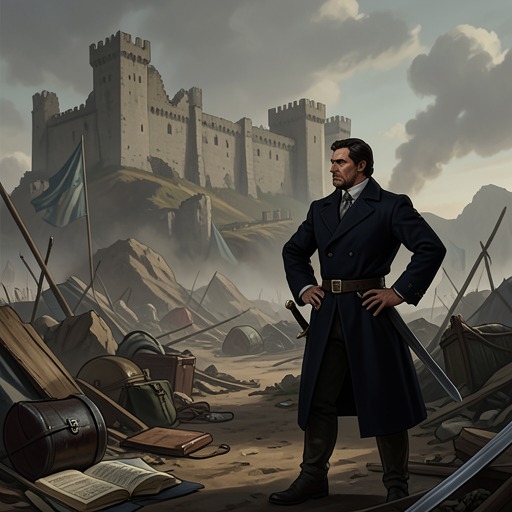
Battle of the Han River
The Romance of the Three KingdomsThe Battle of the Han River is a contest for control of the approaches to Hanzhong, decided less by a single clash than by successive tests of judgment, supply, and nerve. Cao Cao commits a force of two hundred thousand to the campaign; Xuande’s side answers by striking at its provisions and exploiting the river as both obstacle and instrument of deception. Zhao Zilong’s rescue of Huang Zhong, Wang Ping’s break with Cao Cao, and Kong Ming’s carefully staged traps turn a threatened defense into Cao Cao’s retreat toward Yangping Pass.
The campaign and its supply lines
After Xiahou Yuan’s death, Cao Cao launches a two-hundred-thousand-strong army toward Jiameng Pass, determined to crush Xuande. Xuande responds by ordering an attack on the enemy camp and its supplies. Huang Zhong leads the assault and overruns the supply camp, but when he is about to burn the stores, Zhang He attacks and traps him with his men. The raid has opened a chance to disrupt Cao Cao’s provisions, but Huang Zhong’s failure to return creates an immediate danger for Xuande’s forces.
Zhao Zilong goes out to find him. He breaks through the troops surrounding Huang Zhong, scattering them so thoroughly that Zhang He retreats and Huang Zhong is rescued. The episode makes the supply raid more than a contest over provisions: a successful strike depends on recovering the commander and force caught inside it. Zhao Zilong’s intervention restores the endangered detachment and gives Xuande’s side the opportunity to turn back toward its own camp.
Zhao Zilong’s defense and Wang Ping’s warning
At camp, Zhang Yi spots clouds raised by the advancing enemy. He and Zhao Zilong prepare an ambush: Zhao takes his position at the main gate, spear levelled, while Zhang Yi hides archers and crossbowmen nearby. Cao Cao advances and sees Zhao standing alone. His troops rush forward, then hesitate at the sight of the solitary defender. Zhao gives the signal, and the concealed force fires. Cao Cao’s soldiers turn and flee; the supplies are destroyed, and the Wei army withdraws in disorder to Nanzheng. Xuande praises Zhao Zilong, but the respite is brief: Cao Cao advances again toward the River Han.
Xu Huang and Wang Ping share command of the new advance. Wang, who knows the area, urges Xu Huang not to cross the river: if the attack goes badly, the force may have no safe way back. Xu Huang disregards the warning, builds a bridge, and crosses. Xuande’s troops attack from all sides, inflicting catastrophic losses; when Xu Huang tries to retreat, many of his men drown in the river. His risky crossing has transformed the river from a route of advance into a lethal barrier to withdrawal.
Xu Huang then blames Wang Ping for failing to rescue him. Wang answers that he had warned him and would not sacrifice their base to retrieve a force that crossed against his advice. That night, Wang sets fire to the camp, causing Xu Huang to panic and abandon it, then crosses the river and surrenders to Zhao Zilong. His defection compounds the damage of the failed crossing: Cao Cao loses both men and a commander with local knowledge, while Zhao gains an ally familiar with the terrain.
Night alarms and the riverbank standoff
Angered by Wang Ping’s defection, Cao Cao advances to the eastern bank, facing Zhao Zilong on the western side. The armies reach a deadlock. Kong Ming sends Zhao with five hundred men to a secluded hillside beyond Cao Cao’s camp and instructs them to make a threatening din when signalled. Kong Ming waits until the enemy camp’s lights go out before giving the signal. Zhao’s men then beat war drums, blow horns, and shout, awakening Cao Cao’s troops, who believe an attack is imminent but find no enemy before them.
The same disturbance recurs on each of the next two nights. By the third, the Wei troops, Cao Cao included, are exhausted and on edge; they withdraw from the riverbank. The tactic makes the enemy’s expectation itself a burden. Zhao’s small force need not attack the camp: uncertainty and repeated lost sleep accomplish the immediate aim of forcing Cao Cao to abandon his position.
The feigned retreat and Cao Cao’s defeat
On Kong Ming’s advice, Xuande crosses the river and camps with the water behind his men. The unusual position confuses Cao Cao, who challenges Xuande. Their dispute over loyalty to the Han court becomes explicit: Cao calls Xuande a traitor, while Xuande accuses Cao of murdering the empress, making himself king, and presuming to use the imperial carriage. The exchange precedes battle, placing their military contest within their opposing claims to political legitimacy.
As the armies engage, Xuande’s troops retreat toward the river, leaving their camps and supplies behind. Cao Cao suspects the apparent gift is a trap: the enemy is backed against the river, yet has abandoned so much equipment and so many supplies. He orders his men to pull back and touch nothing. Kong Ming, however, has already prepared the ambush, and the signal brings Xuande’s forces forward. Xuande leads the center; Zhao Zilong attacks on the right and Huang Zhong on the left. Cao Cao’s troops are routed.
The defeat extends beyond the riverbank. Cao Cao learns that Zhang Fei and Wei Yan have seized Langzhong and Nanzheng, cutting off his retreat. Kong Ming also sends them to capture the grain convoy intended to supply Cao Cao at Yangping Pass. Thus the campaign’s earlier concern with provisions returns as a decisive vulnerability: Xuande’s forces attack not only Cao Cao’s field army but also the route by which it is to be sustained. Cao Cao retreats toward Yangping Pass with his position compromised and his supply line threatened.
Significance
The battle develops through a chain of linked decisions rather than one decisive frontal assault. Huang Zhong’s raid exposes the risk of operating beyond support; Zhao Zilong’s rescue and concealed defense reverse that risk. Xu Huang’s dismissal of Wang Ping’s warning turns the river crossing into a costly failure, and Wang’s subsequent defection makes the loss strategically consequential. Kong Ming then uses a small force and repeated noise to unsettle a much larger army before converting Cao Cao’s caution about the abandoned supplies into a full ambush.
The river organizes both the tactics and the reversals: it checks Xu Huang’s return, separates the opposing camps, and gives Xuande’s unusual position its deceptive force. At the same time, the threatened grain convoy connects local maneuvers to the campaign’s larger stakes. Cao Cao’s retreat is the cumulative result of poor judgment, disrupted supplies, and Xuande’s coordinated use of Zhao Zilong, Huang Zhong, Zhang Fei, and Wei Yan under Kong Ming’s direction.